
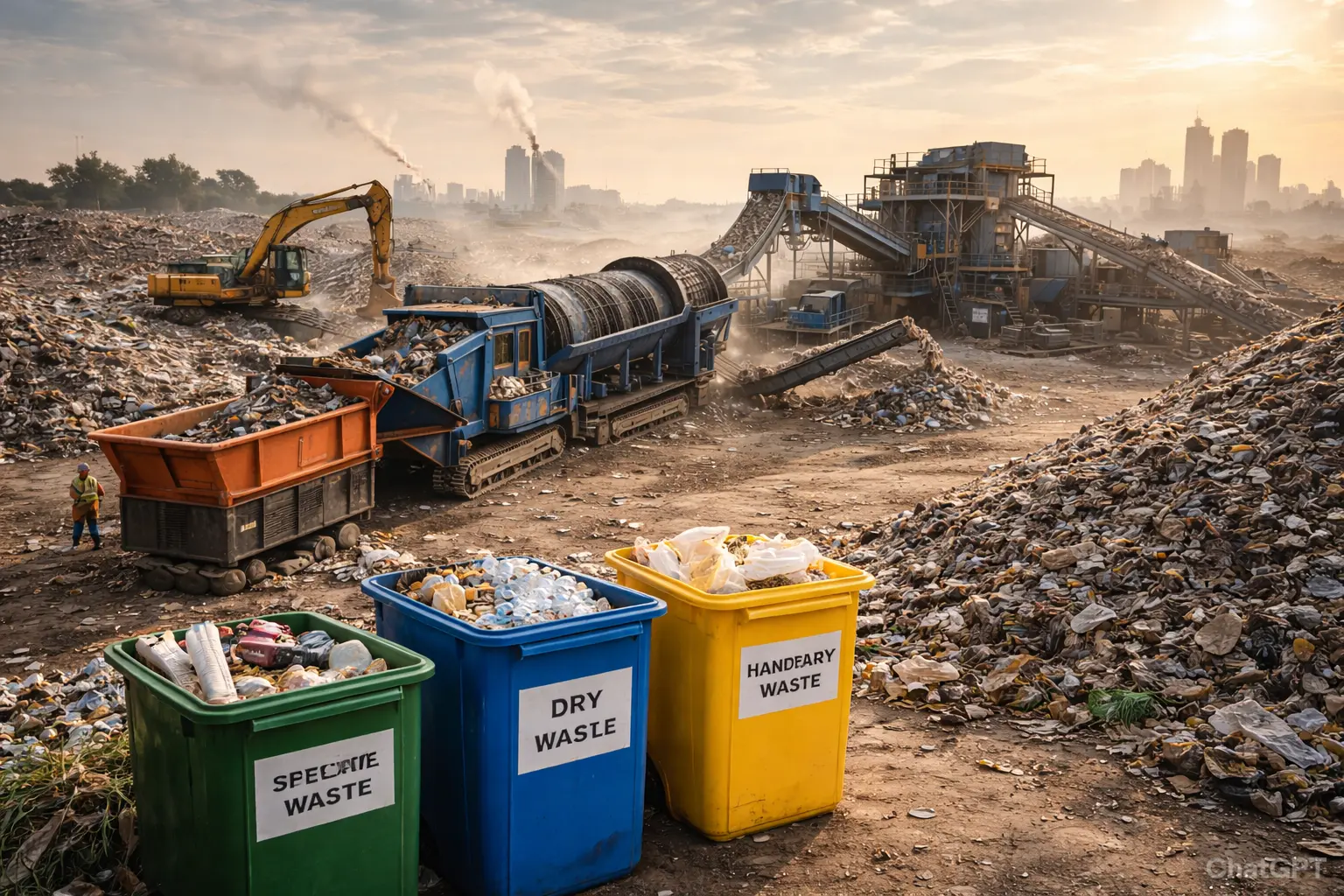
India is entering a new era of environmental accountability. With landfills overflowing and cities struggling to manage growing waste volumes, the government has proposed stronger, technology-backed reforms under the Solid Waste Management (SWM) Rules 2026.
Recent coverage by Down To Earth, Indian Express, Vajiram & Ravi, and The Better India highlights that the new framework emphasizes segregation at source, digital compliance, accountability, and scientific processing.
For industries, municipalities, and waste technology providers, these rules are not just regulatory updates; they represent a structural shift toward sustainable, resource-efficient waste management.
Why India Needed New Waste Rules
India generates over 1.5 lakh tonnes of municipal waste daily, yet a significant portion still ends up untreated in landfills. Mixed waste streams, poor segregation, and limited processing infrastructure have made recovery difficult.
The new rules aim to:
- Reduce landfill dependency
- Increase recycling and composting
- Improve traceability of waste flows
- Hold bulk generators accountable
Simply put, the focus has shifted from “collect and dump” to “segregate, process, and recover.”
Key Highlights of the Solid Waste Management Rules 2026
Mandatory Four-Way Segregation
Waste must now be separated into:
| Waste Type | Examples | Treatment |
|---|---|---|
| Wet / Biodegradable | Food, Garden Waste | Composting / Biogas |
| Dry / Recyclable | Plastic, Paper, Metal | Recycling |
| Domestic Hazardous | Sanitary Pads, Batteries | Special Handling |
| Sanitary/Rejects | Diapers, Contaminated Waste | Incineration/Landfill |
This segregation is compulsory at the source homes, institutions, industries, and commercial spaces.
Without segregation, waste collectors may refuse pickup or impose penalties.
Stronger Responsibility for Bulk Waste Generators
Any entity generating more than 100 kg/day (such as
- Hotels
- Hospitals
- Industrial plants
- Housing societies
- Food processing units
must now manage and treat waste on-site or through authorized processors.
This creates significant demand for:
- Composting systems
- Shredding plants
- RDF lines
- Incineration solutions
Penalties for Non-Compliance
The “polluter pays” principle has been formally introduced. Violations may attract:
- Environmental compensation charges
- Fines
- Legal action
- Suspension of operations
Non-registration or false reporting can also lead to strict penalties.
Digital Monitoring & Tracking

A centralized portal will track waste generation, collection, and processing. This ensures:
- Transparency
- Accountability
- Data-based enforcement
Organizations will need proper documentation and processing records.
What This Means for Industries and Municipalities
Compliance is no longer optional. Businesses must shift from “disposal” to “processing and recovery.”
Required Actions:
- Segregate at the source.
- Reduce landfill disposal.
- Install treatment equipment.
- Adopt recycling and energy recovery.
- Maintain digital reporting.
This transformation demands reliable technology and experienced partners.
Opportunities for the Waste Management Industry
While stricter laws may appear challenging, they create strong growth opportunities.
Demand will increase for:
- RDF/AFR processing lines
- Biomining of legacy waste
- Composting plants
- Incineration systems
- MRFs and segregation lines
Companies providing turnkey engineering, installation, and operations support will be best positioned to benefit.
Forward-thinking industries can transform compliance into cost savings and energy recovery.
How Alfa Therm Supports Compliance
Alfa Therm delivers turnkey waste management and waste-to-energy systems designed for real-world conditions.
We provide:
- Engineering design
- Equipment supply
- Installation & commissioning
- Automation
- After-sales support
Our solutions help organizations:
- Meet regulatory standards
- Reduce landfill dependency
- Recover energy
- Lower operational costs
- Improve environmental footprint
Key Takeaways
- Segregation is compulsory.
- Digital tracking improves enforcement.
- Bulk generators must self-manage.
- Scientific processing replaces dumping.
- Waste tech demand will surge.
India’s SWM Rules 2026 represent a decisive shift toward structured, accountable waste management. For businesses, this is not merely a regulatory change; it’s a call to modernize infrastructure and adopt sustainable technologies.
Organizations that act early will gain operational efficiency, compliance confidence, and long-term cost benefits.
References
- Used Ministry of Environment, Forest & Climate Change (MoEFCC): Solid Waste Management Rules (official notification) https://moef.gov.in/wp-content/uploads/2016/04/SWM-Rules-2016.pdf
- Central Pollution Control Board (CPCB): Solid Waste Management Guidelines https://cpcb.nic.in/solid-waste/
- Press Information Bureau (Government of India): Waste management reforms & compliance updates https://pib.gov.in
- Swachh Bharat Mission Urban – Waste statistics & implementation framework: https://swachhbharaturban.gov.in
Frequently Asked Questions (FAQs)
In short, the SWM Rules 2026 are updated regulations to enforce stricter waste segregation, digital tracking, accountability for bulk waste generators, and scientific waste processing across India.
The Solid Waste Management Rules 2026 will be implemented starting April 2026.
Industries must adopt scientific processing technologies like shredders, MRF lines, composters, incinerators, or RDF to meet compliance and avoid penalties.
Composting systems, material recovery facilities (MRFs), shredders, incinerators, RDF/AFR lines, and biomining solutions support compliance with segregation and processing mandates.
Yes, digital monitoring is mandated to track waste from generation through processing and disposal.