
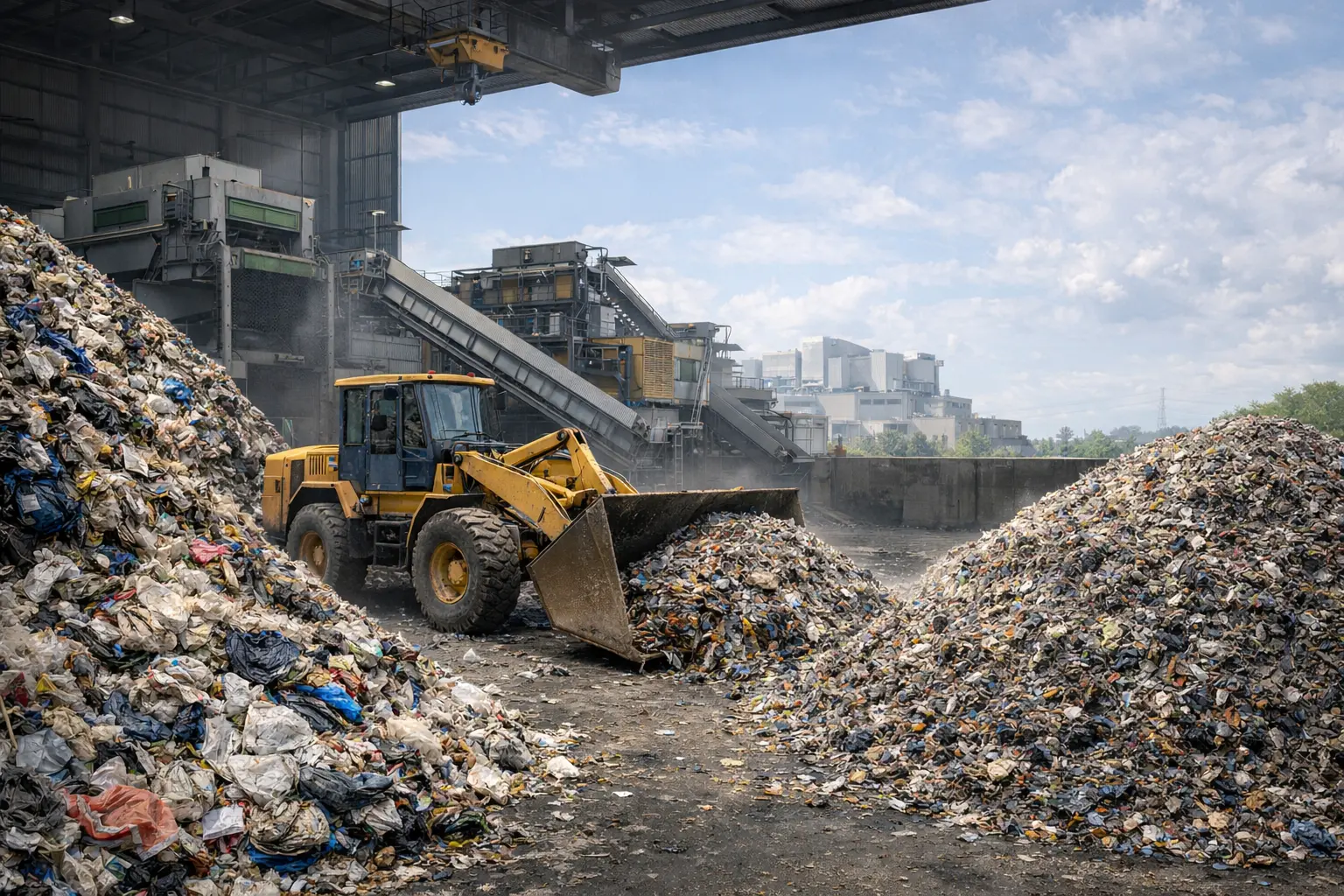
Municipal solid waste (MSW) is growing at an unprecedented rate due to rapid urbanization, population growth, and changing consumption patterns. Traditional disposal methods such as landfilling are becoming unsustainable due to limited space, environmental risks, and greenhouse gas emissions.
One promising solution is Refuse-Derived Fuel (RDF), a processed form of waste that can be used as a reliable energy source. RDF processing plants play a crucial role in transforming everyday waste into usable fuel, helping reduce landfill dependency while contributing to energy generation.
What is RDF (Refuse-Derived Fuel)?
Refuse-Derived Fuel (RDF) is a fuel produced from non-recyclable municipal solid waste, such as plastics, paper, textiles, and organic residues. Instead of being dumped into landfills, these materials are processed, treated, and converted into a combustible fuel.
Key Characteristics of RDF
- High calorific value compared to raw waste
- Reduced moisture and inert content
- Uniform size and composition
- Suitable for combustion or co-processing (e.g., cement kilns, power plants, paper mills, Industrial Boilers)
RDF serves as an alternative to fossil fuels like coal, making it an important component of waste-to-energy (WtE) systems.
Step-by-Step RDF Processing Workflow
The RDF processing plant follows a systematic, conveyor-driven workflow, where waste moves through multiple stages of segregation, sorting, size reduction, and refinement before becoming usable fuel.
1. Apron Feed Conveyor (Waste Feeding Stage)
The process begins with municipal solid waste being loaded onto the apron feed conveyor.
Function
- Heavy-duty steel plates move waste forward
- Designed to handle bulky, uneven, and high-volume waste
- Ensures controlled and continuous feeding into the system
- VFD base to achieve the capacity with controlled speed to prevent blockage.
- It regulates the volume of material sent to downstream equipment. ensures continuous.
This stage stabilizes the entire process by maintaining a consistent material flow.
2. Infeed Conveyor
The waste is conveyed to the infeed conveyor, which carries it toward the primary processing units.
Function
- Transfers material efficiently from the feeder to downstream equipment, ensuring smooth flow and minimizing spillage.
- Regulates material flow into screening and separation equipment
3. Trommel (Primary Screening & Sorting)
The waste enters the trommel, a rotating cylindrical screen.
Function
- Provides size-based screening and partial dust separation
- Efficiently separates fines and oversize material for optimized processing.
4. Dust Removal / Undersize Conveyor
Fine materials separated in the trommel are collected via the dust removal or undersize conveyor.
Function
- Captures and removes airborne dust, inert, and fine particles generated during screening.
- Helping to maintain clean and safe operational conditions.
- Reduces contamination in RDF
5. Oversized Conveyor (Recycling Loop)
Oversized materials separated in the trommel are collected via the oversize conveyor.
Function
- Handles oversized material separated by the Trommel
- Reducing line clogging and improving overall plant efficiency.
6. Air Density Separator with Hood
The remaining waste passes through an air density separator.
Function
- Separates light materials such as MSW fractions (plastics, paper, and cardboard) from heavier waste (stone).
- The hood minimizes dust escape, ensuring environmentally safe operation, and directs separated light materials to the infeed conveyor for further processing.
Importance
- Critical for improving fuel quality
- Ensures only combustible fractions proceed
7. C & D Conveyor (Construction and Demolition)
The separated materials are directed via the C & D conveyor.
Function
- Collects heavier rejects from the air density separator, mainly construction and demolition waste
- Preventing contamination of MSW and lighter fractions.
8. Primary Shredder Infeed Conveyor
Waste is fed into the primary shredder through the infeed conveyor.
Function
- Ensures controlled feeding into the shredder to avoid jamming issue
- Help to achieve capacity.
9. Twin Shaft Shredder (Primary)
- The primary shredder performs the first stage of size reduction.
Function
- High-torque, low-speed dual-shaft shredder ensures uniform size reduction with counter-rotating shafts and replaceable knives.
10. Transfer Conveyor to Secondary Shredder
Shredded material is conveyed to the Secondary Shredder.
Function
- The output of the Primary Shredder is to convey to the Secondary Shredder.
11. Twin Shaft Shredder (Secondary Shredder)
The secondary shredder is used for further reduction in size of the material.
Function
- It is used to further reduce the size of the material.
- It improves the GCV of the RDF.
Importance
- Essential for achieving optimal fuel size
- Improves combustion efficiency
12. Final Output Conveyor (RDF Output)
The processed RDF is discharged via the final output conveyor.
Function
- Convey the final output material to the desired location.
Machinery and System Integration
This RDF plant is a fully integrated mechanical system, where each machine plays a specific role:
Material Handling Systems
- Apron feeder
- Infeed conveyors
- Transfer conveyors
- Final output conveyor
Ensure continuous and automated flow of waste.
Separation Systems
- Trommel
- Air density separator
Remove non-combustible and unwanted materials.
Size Reduction Systems
- Primary shredder
- Secondary shredder
Convert waste into a reduced size to achieve more GCV.
Benefits of RDF Processing Plants
1. Waste Reduction
Significantly reduces landfill volumes.
2. Energy Recovery
Converts waste into a valuable energy resource.
3. Reduced Fossil Fuel Dependency
RDF can replace natural fuel (like coal) in various industries.
4. Improved Waste Management
Encourages systematic segregation and processing.
5. Economic Advantages
Lower waste disposal costs
Revenue from energy generation
Future Trends in RDF and Waste-to-Energy
1. Advanced Automation
AI-based sorting and smart monitoring systems.
2. Integration with Circular Economy
Greater focus on recycling and energy recovery.
3. Improved Emission Technologies
Cleaner combustion and gasification methods.
4. Hybrid Systems
Combination of RDF with renewable energy sources.
5. Policy and Regulatory Support
Governments are promoting waste-to-energy solutions.
RDF processing plants represent a practical and scalable solution for managing municipal waste while generating energy. By converting non-recyclable waste into fuel, these systems help reduce landfill dependency, lower environmental impact, and support sustainable energy practices.
However, their success depends on proper waste segregation, advanced technology, and strict environmental compliance. As waste generation continues to rise, RDF will play an increasingly important role in global waste management strategies.
Frequently Asked Questions (FAQs)
RDF (Refuse-Derived Fuel) is a processed Alternate fuel made from non-recyclable municipal waste used for energy generation.
It involves screening, sorting, shredding, drying, and densifying waste into fuel suitable for combustion or gasification.
It reduces landfill waste and fossil fuel use but requires proper emission controls to minimize environmental impact.
RDF is used in cement kilns, power plants, and industrial boilers.
Typically ranges between 2,500–4,500 kcal/kg depending on composition.
Yes, when proper systems and regulations are followed.