

What is AFR / RDF?
AFR (Alternative Fuel & Raw Material)
AFR refers to waste-derived materials that can be used as fuel or a raw material substitute in cement and industrial production processes.
RDF (Refuse-Derived Fuel)
RDF is produced from combustible fractions of municipal and industrial waste such as plastics, paper, textiles, rubber, wood, and packaging material.
These fuels help reduce carbon emissions and minimize landfill waste while generating economic value from waste materials.
AFR / RDF Processing Plant Working Principle
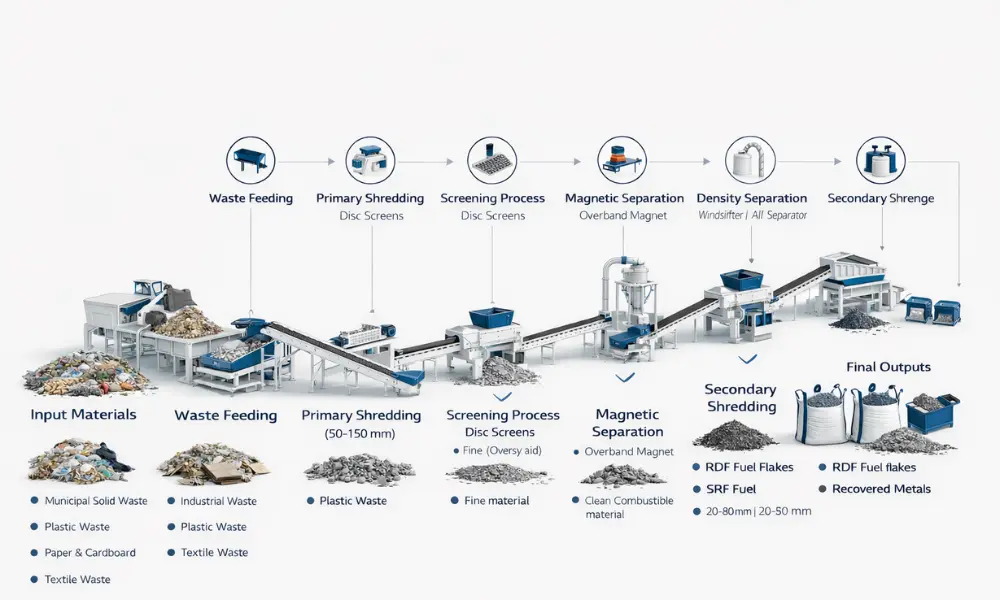
The plant processes mixed waste through multiple stages, such as shredding, screening, metal separation, density separation, and size reduction to produce high-calorific alternative fuel suitable for industrial combustion.
The typical calorific value of RDF fuel ranges between 2500 – 4500 kcal/kg, depending on material composition and processing method.
Process Flow of AFR / RDF Plant
Waste Feeding
Municipal solid waste, industrial waste, commercial waste, plastic waste, and packaging waste are fed into the plant using conveyor systems or loaders.
- Municipal solid waste (MSW)
- Industrial waste
- Plastic waste
- Paper & cardboard
- Textile waste
- Rubber waste
- Packaging waste
Primary Shredding
Waste material is reduced into smaller pieces (50–150 mm) using a high-torque shredder. This ensures uniform size for further processing and efficient separation.
Primary shredding prepares the waste stream for screening and classification processes.
Screening Process
Screening equipment separates fine particles and oversized materials to achieve a consistent particle size suitable for fuel production.
Oversized material is recirculated for further shredding.
Purpose:- Remove inert materials
- Improve fuel quality
- Maintain uniform particle size
Magnetic Separation
Ferrous metals are removed using overband magnetic separators to protect downstream equipment and improve fuel purity. Output:
Output:- Clean combustible material
- Recovered metal scrap
Air Separation / Density Separation
Air classifiers or wind sifters separate heavy materials such as stones, glass, and metals from light combustible materials like plastic film, paper, and textiles.
The light fraction has a high calorific value and is used for RDF fuel production.
Secondary Shredding
Material is further reduced into a smaller size (20–80 mm) suitable for use as RDF fuel in cement kilns or industrial furnaces.
Uniform particle size improves combustion efficiency and handling.
Final RDF Storage
Processed fuel is stored in bunkers, silos, or jumbo bags for transportation to cement plants, power plants, or industrial boilers. Final Output:
- Recovered metals
- Recovered metals
RDF can be used as a substitute fuel in cement kilns, reducing coal consumption and greenhouse gas emissions.
Input Materials for AFR / RDF Plant
The plant can process a wide variety of waste materials:
- Municipal solid waste (MSW)
- Commercial waste
- Industrial waste
- Plastic waste
- Paper & cardboard
- Textile waste
- Packaging material
- Wood waste
- Rubber waste
Material composition can be customized based on fuel requirements.
Output Products
RDF Fuel Fluff
Yield: 20–80 mm
Usage: Cement kilns
Processed Waste Fuel
Yield: Custom size
Usage: Power plants
Recovered Metals
Yield: NA
Usage: Scrap recycling
Plant Capacity Options
Plant capacity depends on waste composition, moisture content, and fuel specification requirements.
Key Features of Alfa Therm AFR / RDF Processing Plant
- High-efficiency shredding system
- Advanced screening technology
- Magnetic metal separation
- Air classification system
- Uniform fuel particle size
- High calorific fuel output
- Continuous automatic operation
- PLC-based control panel
- Heavy-duty industrial design
- Low operating cost
- Modular plant structure
- Custom capacity options available
Advantages of AFR / RDF Processing Plant
Applications of RDF Fuel
RDF fuels are widely used in energy-intensive industries:
- Cement plants
- Lime plants
- Thermal power plants
- Steel plants
- Paper mills
- Industrial boilers
- Waste-to-energy plants
These fuels reduce fossil fuel consumption and support sustainable energy production.
Why Choose Alfa Therm Limited?
Alfa Therm Limited provides complete turnkey AFR/RDF processing solutions, including design, manufacturing, installation, and technical support. We provide:
- Customized plant design
- High-performance machinery
- Energy-efficient systems
- Reliable operation
- Competitive pricing
- Strong after-sales support
- Proven waste processing technology
FAQs
RDF is fuel produced from combustible waste materials such as plastic, paper, textiles, and packaging waste.
RDF fuel is mainly used in cement plants, power plants, and industrial furnaces.
Typically ranges from 2500 to 4500 kcal/kg depending on waste composition.